The present castle is situated upon the site of the original fortress built by the Lusignans: no doubt about its ancient origin since it is said that the "Fairy Melusine" was its ancestor. In the Middle Ages, the Lusignan family became powerful, allowing one of its branches to ascend to the throne of Cyprus and Jerusalem at the beginning of the 13th century. Hugues XI de Lusignan fell out with St. Louis who seized Cherveux in 1242 and gave it to his brother Alphonse, Comte du Poitou. Hugues proved his allegiance to his lord the king by accompanying him on the crusades. He died in a battle just after arriving in Egypt in 1249.
The castle was given back to Hugues' descendants, then it passed into the hands of the Mello family, then the Craon family and finally to that of Chalon. It was then taken by the English under the reign of Edward III in 1363 and was given to William of Felton, the Seneschal of Poitou. After the conquest of the province by Du Guesclin, Cherveux was returned to the Chalon family whence it passed to the La Trémoille line who in turn sold it in 1457 to Amaury d'Etissac, lord of Coulonges-les-Royaux, who yielded it to Jean de Naydes, who in his turn sold it to the Chenin family.
Their daughter Louise Chenin married Robert Conningham in May 1440. Of Scottish origin, captain of the bodyguard of the king (extremely well in court under Louis XI), Cunningham (or Conygham according to texts of the BNF) had the means to erect the whole of the present castle in one single effort about 1470.
"The Scots and the French were bound together by the Auld Alliance. The Scots Guard – 'Garde Écossaise' – was founded in 1418 by Charles VII of France. The Scots soldiers of the Garde Écossaise fought alongside Joan of Arc against England during the Hundred Years' War. In March 1421, a Franco-Scots force under John Stewart, 2nd Earl of Buchan, and Gilbert de Lafayette, defeated a larger English army at the Battle of Baugé. Three years later, at the Battle of Verneuil, the Scots lost around 6,000 men, including John Stewart. The Garde Écossaise was seen as an elite military unit. Louis XI of France had them act as personal bodyguards to the French monarchy. In return for service, Scottish soldiers were often granted honourable positions and lands in France." — Education Scotland
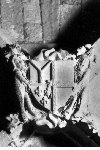
Cunningham Coat of Arms
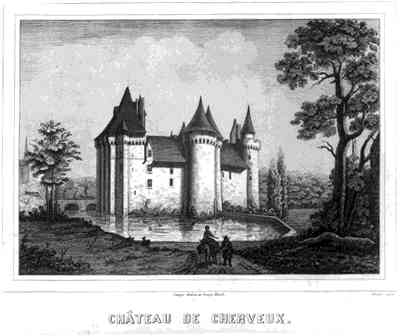
Old Engraving of the Castle
Later, Cherveux was passed via successive marriages to the Puyguyon and St. Gelais families. Although it was a principal, formidable stronghold, it was nevertheless taken in 1569 by the Marquis of Lude who installed a garrison of swordsmen, and then again in 1574 by the Duc de Montpensier. Until the 18th century, it was held by the Plessis-Châtillon family who were succeeded by the Narbonne-Pelet family.
It was confiscated by the nation of France and sold 3 years after the French Revolution to Pierre Alloneau. Descendants of Alloneau (the Clouzot Meynier family) preserved it until 1931 and sold it to Mr. and Mrs. Lucien Redien, whose family has restored and preserved the castle and farmed the land since 1912.
The castle was listed as an Historic Monument on September 16, 1929. It is now owned by Mr. and Mrs. Eckel.